Operation Paperclip: The History of the Secret Program to Bring Nazi Scientists to America During and After World War II by Charles River Editors
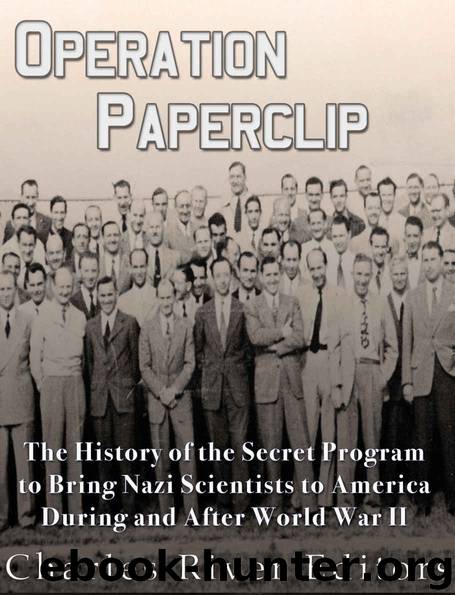
Author:Charles River Editors
Language: eng
Format: epub
Publisher: Charles River Editors
Published: 2016-06-05T16:00:00+00:00
Chapter 6: The Soviet Union’s Acquisition Efforts
Due to the speed and force of the final American drive into Germany, U.S. soldiers occupied many areas designated as Soviet zones at Yalta. Some of the soldiers and commanders expressed disgust at abandoning this territory to the Soviets after fighting to secure it, but the Western Allies adhered to the letter, if not the spirit, of their agreements. Nevertheless, the Americans removed as much scientific material (and as many scientists) as possible from these zones during their brief occupation.
The Soviets' own scientific teams often found the regions picked bare of technological prizes once the Americans vacated them, but the USSR did not come away empty-handed. The Soviets, in fact, carried out a similar stripping of American sectors in reverse when they took Berlin. The Kaiser Wilhelm Society Institute for Physics, its director Peter Adolf Thiessen, and a number of its scientists fell into Soviet hands. The Red Army's scientific teams, equivalent to the western T-Forces, also managed to secure many chemical, biochemical, and silicate research labs plus their personnel in the Berlin area.
The bribes brought by these teams added a bizarre touch to the proceedings: “The dismantlers showed up at the institutes with vodka and lard: vodka for the local military commandants, whose cooperation was necessary for quickly transporting the labs, lard for the German scientists, to convince them that the Soviets were serious about taking care of them.” (Naimark, 1995, 209).
The Soviets, knowing that the Americans would permit the German scientists to leave if they wished to, attempted to take advantage of the much more liberal U.S. attitude towards the Third Reich's inventors and engineers. During the interrogation of these individuals at sites in Germany and in Paris during summer 1945, the various Allies naturally had the right to send their own representatives to the interviews, so the Soviet interrogators approached the German scientists with smoothly plausible claims, offering them considerable rewards and promising they could conduct their research in Germany.
Von Braun and most of the other scientists politely declined these offers, knowing them to be outright lies and fearing what the Soviets would do if they voluntarily joined those of their peers already captured by the Red Army. Helmut Gröttrup, however, naively believed the Soviets' blandishments, and the Americans, in keeping with their general policy, allowed him to leave. As soon as Gröttrup reached the Soviet-controlled area of Germany, however, he found himself bundled onto a train with his wife and other high-value scientists and their families. Under guard, the Germans traveled to remote sites in Siberia, where they spent years imprisoned (albeit well-fed and kept relatively comfortable). Von Braun noted that the Russians “let them see nothing, touch nothing on the production end, learn nothing from developing experience, just had them write reports until they were drained dry. Then the Russians went on by themselves.” (Spangenburg, 2008, 79).
The Soviets also bagged the famous Gustav Hertz, taking him and the entire Siemens laboratory to Moscow. General A.P. Zaveniagin headed the collection
Download
This site does not store any files on its server. We only index and link to content provided by other sites. Please contact the content providers to delete copyright contents if any and email us, we'll remove relevant links or contents immediately.
Personalized inhaled bacteriophage therapy for treatment of multidrug-resistant Pseudomonas aeruginosa in cystic fibrosis by unknow(178735)
CONSORT 2025 statement: updated guideline for reporting randomized trials by unknow(87255)
Critical evaluation of the ProfiLER-02 study design and outcomes by Vivek Subbiah & Razelle Kurzrock(86837)
Cardiac gene therapy makes a comeback by Oliver J. Müller & Susanne Hille & Anca Kliesow Remes(86586)
Whisky: Malt Whiskies of Scotland (Collins Little Books) by dominic roskrow(74443)
Unveiling the design rules for tunable emission in graphene quantum dots: A high-throughput TDDFT and machine learning perspective by Şener Özönder & Mustafa Coşkun Özdemir & Caner Ünlü(50896)
A yeast-based oral therapeutic delivers immune checkpoint inhibitors to reduce intestinal tumor burden by unknow(40265)
Covalent hitchhikers guide proteins to the nucleus by Alexander F. Russell & Madeline F. Currie & Champak Chatterjee(40217)
Meet the Authors: Christopher R. Mansfield and Emily R. Derbyshire by Christopher R. Mansfield & Emily R. Derbyshire(40099)
Alkaline-earth metals promote propane dehydrogenation with carbon dioxide through geometric effects: Altering the reaction pathway by unknow(32736)
Induced iron vacancies boosting FeOOH loaded on sustainable Fenton-like collagen fiber membrane for efficient removal of emerging contaminants by unknow(32511)
Efficient electric-field-assisted photochemical conversion of methane to n-propanol exclusively over penetrated TiO2Ti hollow fibers by Guanghui Feng(32456)
Bi2SiO5 nanosheets as piezo-photocatalyst for efficient degradation of 2,4-Dichlorophenol by Hangyu Shi & Yifu Li & Lishan Zhang & Guoguan Liu & Qian Zhang & Xuan Ru & Shan Zhong(32392)
A novel NDIPTA organic heterojunction photocatalyst with built-in electric field for efficient hydrogen production by Jiahui Yang & Baojun Ma & Yongfa Zhu(32367)
Enhanced conversion of methane to liquid-phase oxygenates via hollow ferrite nanotube@horseradish peroxidase based photoenzymatic catalysis by Jun Duan & Shiying Fan & Xinyong Li & Shaomin Liu(32333)
Ordered macroporous superstructure of defective carbon adorned with tiny cobalt sulfide for selective electrocatalytic hydrogenation of cinnamaldehyde by Xiao-Shi Yuan & Sheng-Hua Zhou & San-Mei Wang & Wenbo Wei & Xiaofang Li & Xin-Tao Wu & Qi-Long Zhu(32260)
What's Done in Darkness by Kayla Perrin(27152)
Topological analysis of non-conjugated ethylene oxide cored dendrimers decorated with tetraphenylethylene: Insights from degree-based descriptors using the polynomial approach by A Theertha Nair & D Antony Xavier & Annmaria Baby & S Akhila(26534)
Investigation of mechanical and self-healing properties of hydroxyl-terminated polybutadiene functionalized with 2-ureido-4-pyrimidinone by Mohsen Kazazi & Mehran Hayaty & Ali Mousaviazar(26461)
